
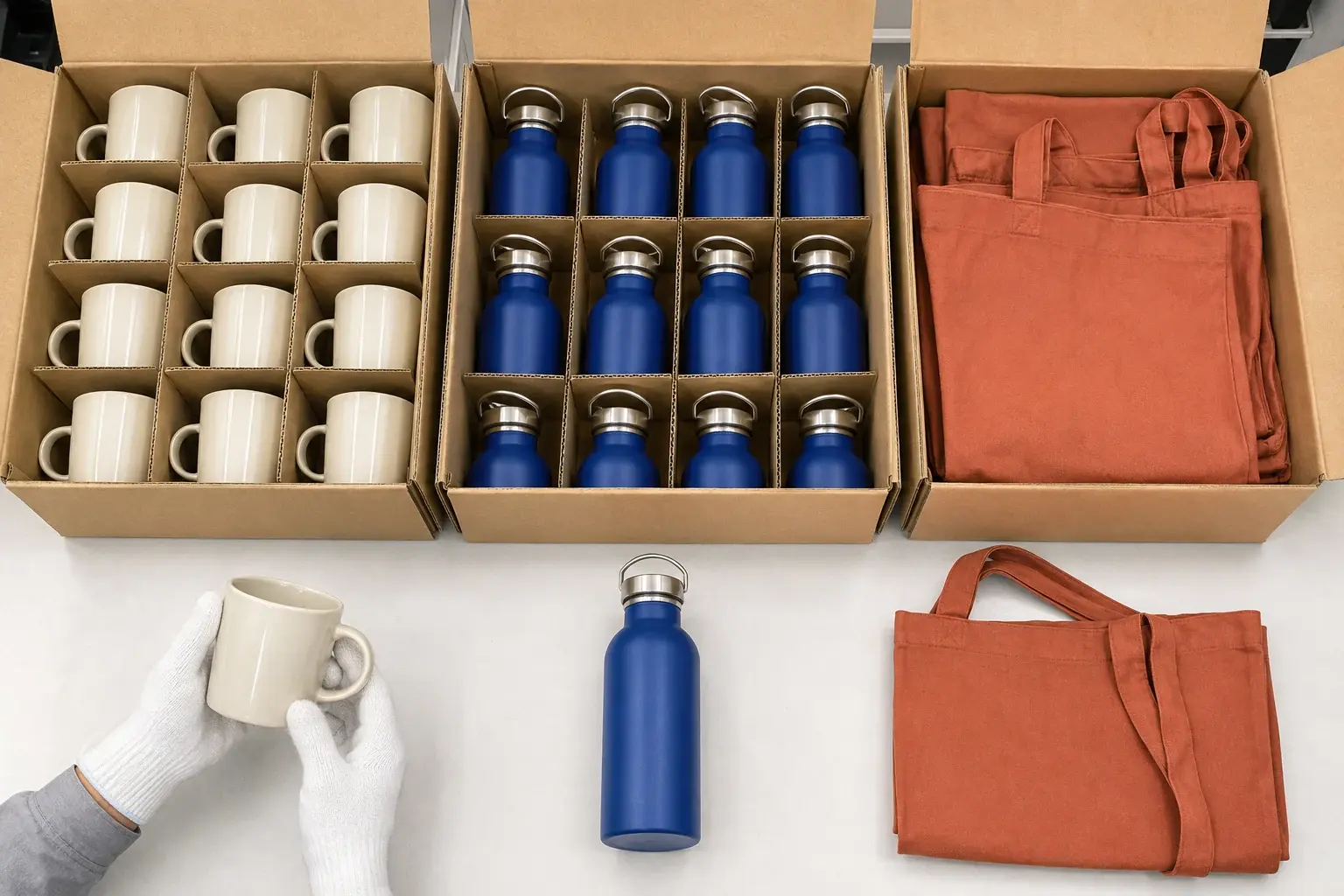
On a mixed order the sampling question is which lots to treat separately. How to allocate samples across SKUs so the small lines are not inspected by accident.
LINKORA SOURCE · FIELD GUIDE
Inspect every SKU in the plan
Mugs
Rim · handle · finish
Bottles
Closure · finish · function
Totes
Seams · size · decoration
Coverage
Allocate samples by SKU and risk
Decide what counts as a lot before anyone draws a sample
Sampling plans indexed by acceptance quality limit are applied lot by lot, so the first decision on a mixed order is which items form a lot. Treating an entire mixed shipment as one lot produces a sample dominated by whichever SKU has the largest quantity, and a defective small line can pass inside it untouched. Treating every variant as its own lot is statistically clean but can produce more sampling than the order justifies. The usual compromise is to group by product family and production process, and to keep any SKU with a distinct material, tooling or decoration as its own lot.
- A mixed shipment is not one lot unless you decide it is
- Group by product family and process, not by convenience
- Distinct material, tooling or decoration means a separate lot
Where the samples should actually go
A flat allocation across a long line list wastes attention on items that carry little risk. Weight it instead: more samples where the value is concentrated, where the SKU is new, where the last order produced findings, and where a defect would be visible to your customer rather than hidden in a carton. Low-value repeat lines that have been clean for several orders can carry a lighter check, provided that decision is written down and revisited, rather than becoming a habit nobody remembers agreeing to.
- Weight sampling by value, novelty and past findings
- New or changed SKUs get the heaviest attention
- Any reduction in coverage is recorded as a decision, with a review date
The failure modes that only appear on mixed orders
Some problems belong specifically to multi-SKU work. Variants get mixed between cartons, or a carton is labelled as one SKU and packed with another. Quantities are short on one line and over on another because the packing was reconciled at the total rather than per line. Artwork intended for one variant is applied to its neighbour, which is easy when two colourways share a carton design. Each of these is found by reconciling the packing list against physical counts per SKU, not by looking harder at the product itself.
- Carton contents reconciled against the label, per SKU
- Counts checked per line, not only against the shipment total
- Variant-specific artwork verified on the variant it belongs to
One report a buyer can act on
A report that gives a single overall verdict on a mixed order is not usable, because the decision you have to make is per line: ship, rework, hold or short-ship. The report should carry a result per SKU with its own sample size and defect counts, photographs tied to the SKU they came from, and a clear statement of what was not checked. An overall summary is useful on top of that, never instead of it. Where a line is rejected, the report should also say whether the defect is reworkable at the factory and roughly what that would take, because ship-or-hold is rarely the only choice available.
- A result, sample size and defect count per SKU
- Photographs attributed to the SKU they document
- Explicit list of lines not covered, and why
What the result does and does not tell you
An AQL result is a judgement about a lot based on a random sample, not a guarantee about every unit in it, and that remains true per SKU on a mixed order. Where a property cannot be judged by sampling at the factory — composition, durability, an electrical safety requirement — the report should name it as out of scope rather than let its absence imply a pass. We inspect against the specification and the approved sample you supply; laboratory testing is commissioned by you directly from the laboratory, and we do not issue certification-scheme reports of any kind.
- A lot judgement per SKU, not a per-unit guarantee
- Properties needing laboratory testing named as out of scope
- Testing commissioned by the buyer, direct with the laboratory
Authoritative references
Need this applied to your sourcing brief?
Tell us the product, market and decision you need to make. We will confirm whether a scoped sourcing, verification or quality service is suitable.
Start a sourcing brief