
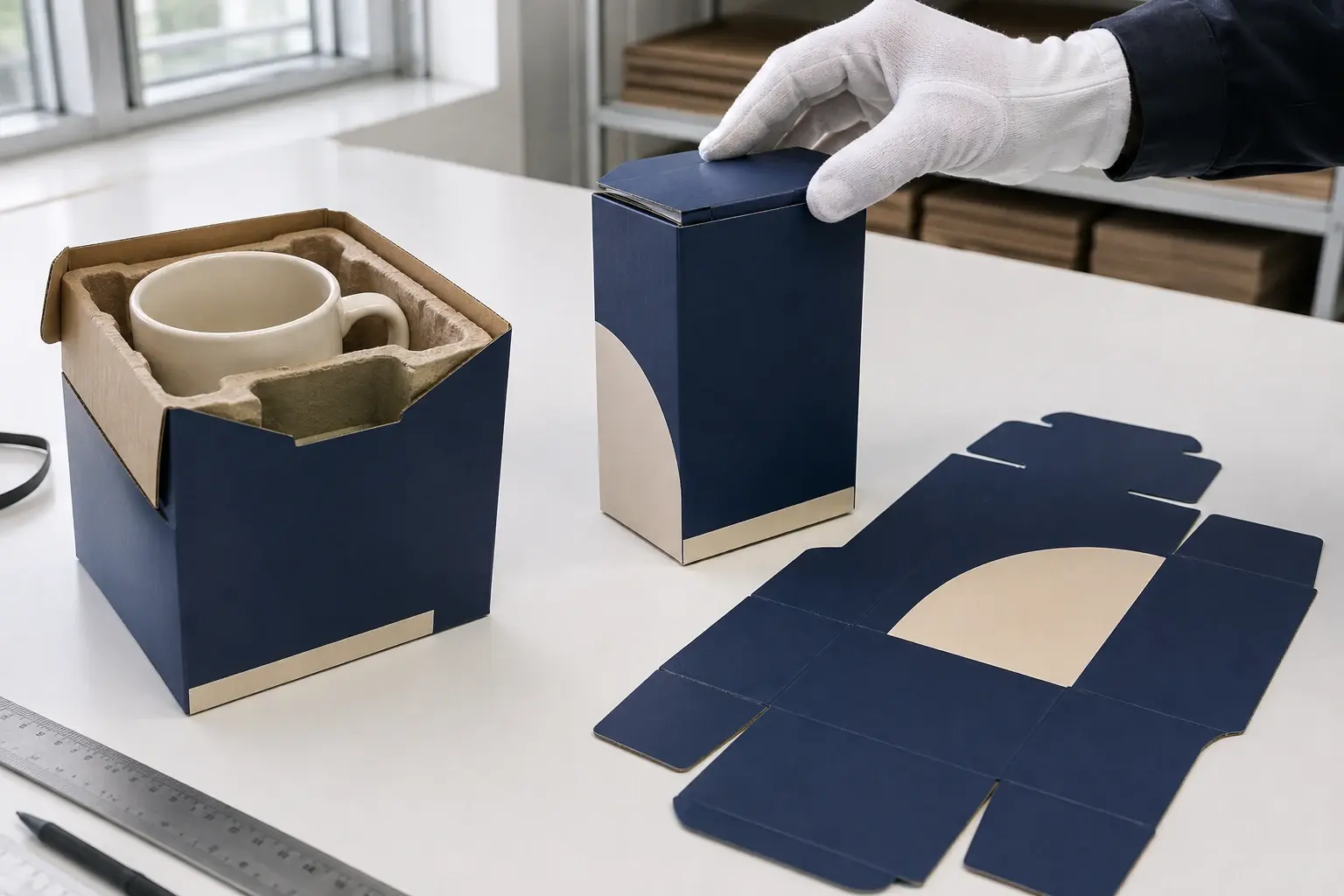
How to check retail packaging against the artwork, dieline, colour reference and barcode you approved — and what a factory will never infer on its own.
LINKORA SOURCE · FIELD GUIDE
Inspect the finished pack
Print
Proof · artwork version · colour
Structure
Folds · glue · closure
Fit
Insert and product protection
Identification
Barcode scan and approved wording
Approve a physical proof, then inspect against it
Screens are not production references. Approve a printed proof on the actual substrate with the actual finish, record which artwork version it came from, and keep it. At inspection the comparison is proof against production, under consistent light, for colour, register, position and finish. Where a brand colour is critical, a numbered colour system gives both sides a common target — but substrate, ink system and finish all change how that target lands, which is exactly why the physical proof, not the number, is the thing that gets approved.
- Printed proof on the real substrate and finish, tied to an artwork version
- Comparison made under consistent light, not against a screen
- Colour system reference recorded alongside the approved physical proof
Check the structure, not just the print
Structural faults are the ones that survive proofing and fail in the field. Check the dieline against the approved drawing, the board grade and thickness, the glue lines, the fold and crease quality, insert fit, and whether the closure works on the tenth open rather than only the first. A box that looks right flat and buckles when packed is a common and expensive outcome, and it is only caught by assembling and packing one at the inspection. Ask for the same check on the shipping carton: an outer that arrives crushed makes the retail box inside irrelevant.
- Dieline, board grade, glue and crease quality checked physically
- Insert fit and closure tested on assembled, packed units
- At least one unit built up and packed during the inspection
Barcodes are checked by scanning, not by looking
A barcode that prints cleanly can still fail at a till or a warehouse scanner because of size, quiet zone, contrast or the substrate it sits on. Retail trade items are identified by a GTIN built from a GS1 company prefix licensed to your business, so the number itself must be yours and must match the item it is on. Then scan-test it at inspection on the finished pack, along with the check that the number printed matches the SKU it belongs to, which is the failure that costs most when two variants share a carton design.
- GTIN issued under your own GS1 company prefix
- Scan test on the finished pack, not a proof-read of the digits
- Verify the barcode matches the variant it is printed on
The text that is not a design decision
Some of what appears on a pack exists because a market requires it: the responsible-operator details, country of origin, warnings, materials or care information, and any category-specific marking. These are compliance items with a legal basis, not layout preferences, and they should be listed as checkable lines with their exact wording. Confirm the requirements for your destination markets with your own adviser and give us the finished text — we check that what is printed matches what you approved, we do not determine what your market requires.
- Mandatory text listed as exact wording, not as an intention
- Country of origin, warnings and category marking checked as line items
- The regulatory requirement itself comes from your own adviser
Where our scope on packaging ends
We inspect packaging against the artwork, dieline, colour reference, barcode and packing method you have already approved, and report differences with photographs and measurements. We do not design packaging, do not create or amend artwork, and do not source packaging suppliers on your behalf. Where a fault is in the design rather than in the execution — an insert that cannot protect the product, a closure that fatigues after a few uses — we will say so in the report, because you would rather hear it from us than from a review. The redesign itself belongs with your own designer or structural engineer.
- We verify execution against your approved references
- No packaging design, artwork creation or packaging sourcing
- Design faults reported as findings, and referred back to your designer
Authoritative references
Need this applied to your sourcing brief?
Tell us the product, market and decision you need to make. We will confirm whether a scoped sourcing, verification or quality service is suitable.
Start a sourcing brief