
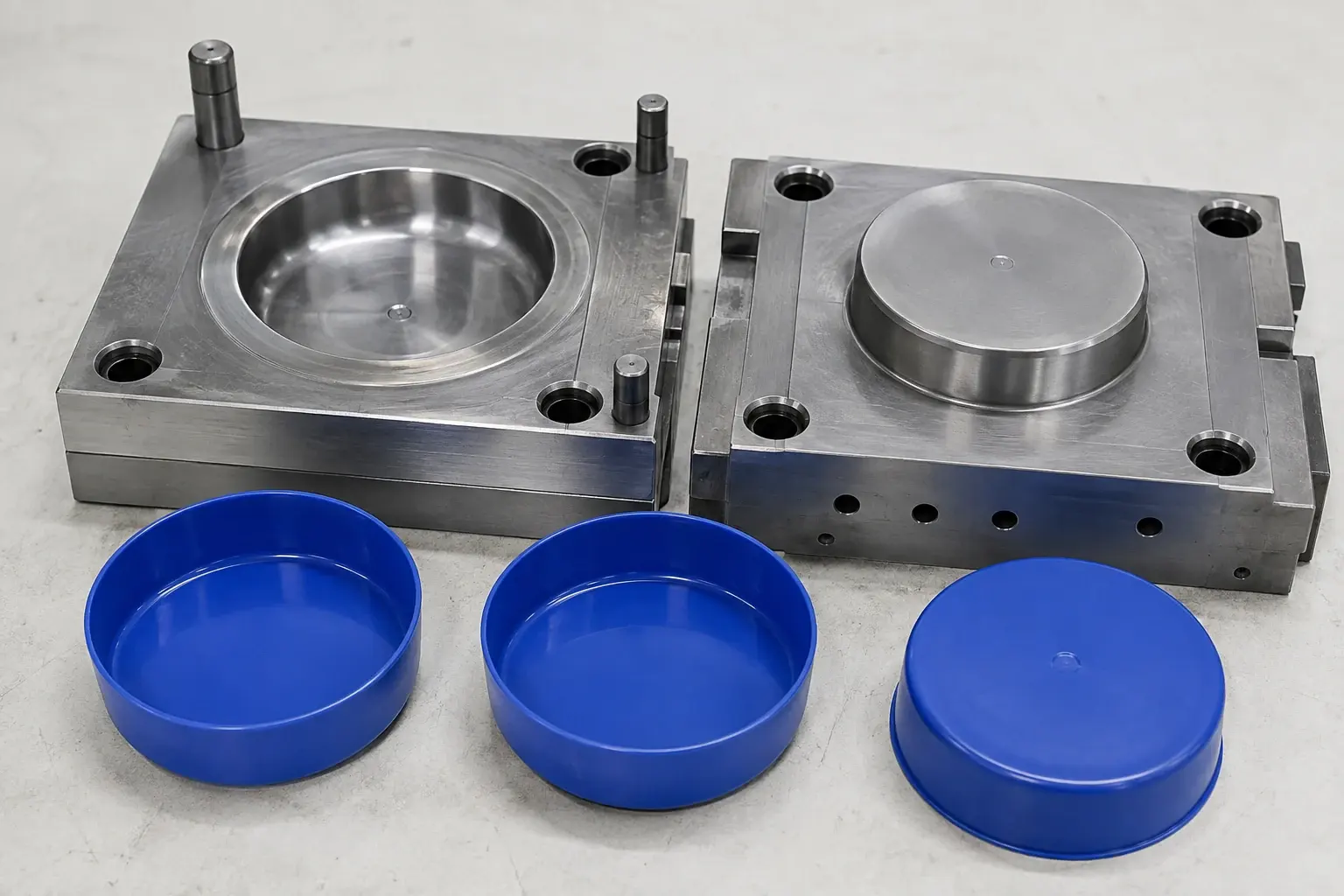
What a private mould actually buys you, what it costs beyond the quotation, and the checks worth completing before the tooling payment leaves your account.
LINKORA SOURCE · FIELD GUIDE
Tooling checks follow the same part
Identify
Tool ID · location · cavity
Trial
Samples from the actual tool
Compare
Approved drawing and sample
Record
Visible condition and differences
What tooling buys, and what it does not
A private mould gives you a part no competitor can order from the same factory, which is worth funding when the differentiation is something a customer can see or feel and would choose on. It does not, by itself, protect the design: a mould stops another buyer ordering your exact part from that factory, while a determined copier reverse-engineers a product that sells well regardless. It also does not fix quality, because a bad supplier with your tooling is still a bad supplier — with the added problem that your money is now sitting in their building.
- Fund tooling for differentiation a buyer can perceive, not for the sake of owning a mould
- Tooling is a commercial moat against the same factory, not intellectual-property protection
- Verify the supplier before the tool, not after — tooling makes switching much harder
The costs that are not on the tooling quotation
The quoted figure usually covers cutting the steel and some number of trial rounds, and the rest arrives afterwards. Further modification rounds are billable once the included ones are used. A tool has a working life measured in shots, and maintenance, wear and eventual replacement inserts all have an owner that the agreement should name. Time is the other cost: a development cycle runs across design, first trial, sample rounds and a first production run, so the money leaves months before the first unit is sellable and the cash gap is usually underestimated more than the price is.
- Confirm how many trial and modification rounds the price includes, and the cost of another
- Agree who pays for maintenance, for wear, and for a replacement insert — they are different questions
- Plan for the cash gap between the tooling payment and the first sellable unit
The checks that belong before the payment
Tooling is the payment with no route back, so the work belongs in front of it: confirm the registered entity that will hold the tool is the entity on your contract, and assess the site where the tool would be cut, stored and run. Once the mould exists it can be identified on site — whether a tool matching the part is present at the stated address, its identification marking, its cavity count against the output you were quoted, and its visible condition. Ownership itself is a contract question and belongs with a qualified lawyer, but the commercial points an agreement should settle can be worked out in advance so the lawyer drafts your decisions rather than making them.
- Confirm the entity holding the tool is the entity on the contract, before the payment
- After the tool is cut: identification marking, cavity count and condition, checked on site
- Settle ownership, location, maintenance and release terms in writing — drafted by a lawyer
Authoritative references
Need this applied to your sourcing brief?
Tell us the product, market and decision you need to make. We will confirm whether a scoped sourcing, verification or quality service is suitable.
Start a sourcing brief