
Brands developing custom products · Updated 20 August 2026
China OEM and ODM sourcing for brands developing custom products
Custom development commits money before the product exists: tooling, moulds and formulation trials are paid for against drawings, and that spend does not travel if the supplier turns out to be the wrong one. On-site mould and tooling checks are a standard part of the work here — identifying the tool, reading its marking, counting its cavities and assessing its condition. The exposure is not a bad batch; it is arriving at a supplier you can no longer leave.
Start a sourcing brief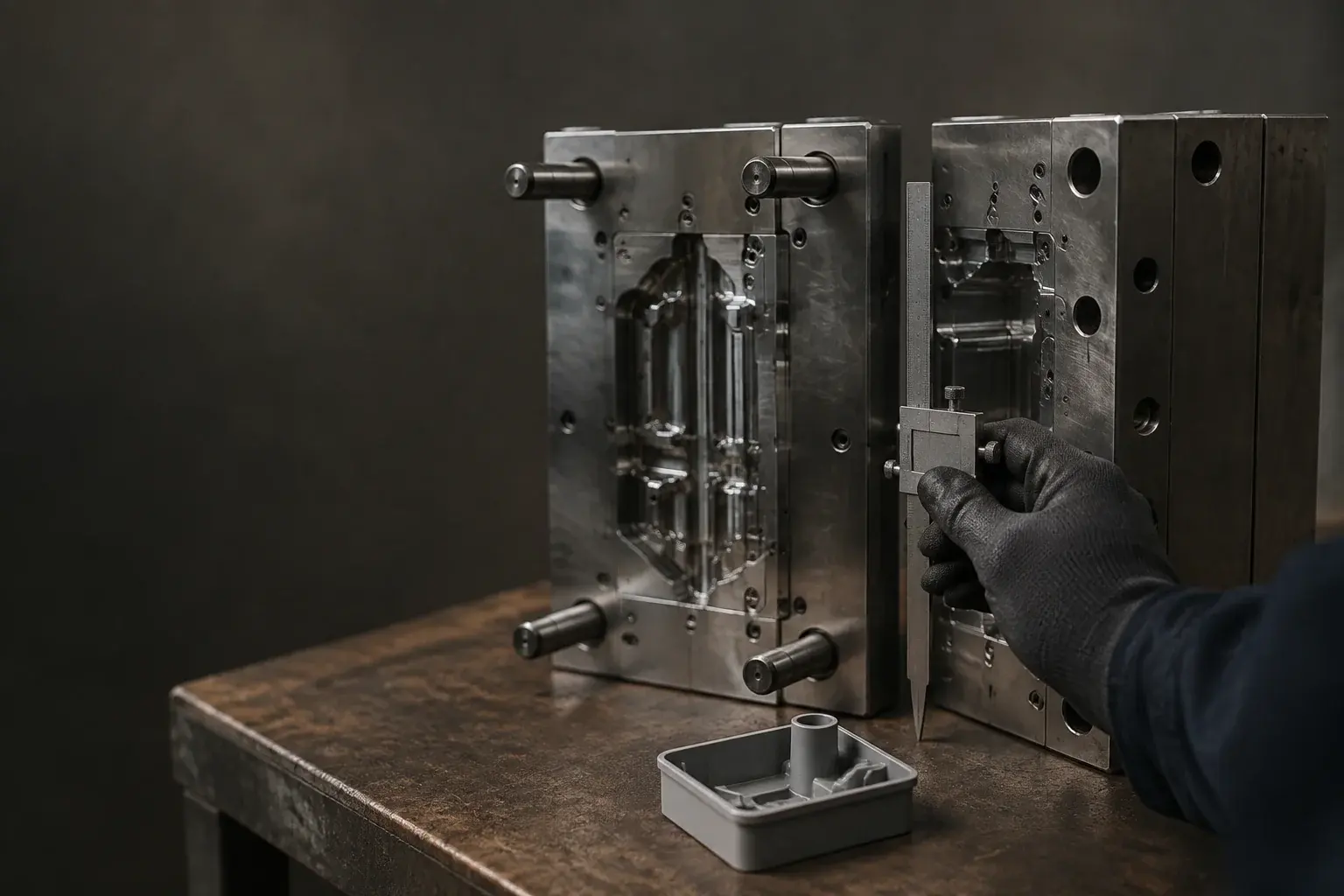
This is written for you if
- You are commissioning a product that does not exist yet, from your own drawings, samples or brief
- You are paying for tooling, moulds, dies or a bespoke formulation
- You have already paid for a tool and want it identified, marked and its condition recorded where it sits
- You are adapting an existing supplier design into a version that becomes yours
- A first production run is due and you need it judged against the standard you approved rather than a general quality opinion
You probably do not need us if
- Your design is still a concept and you need industrial design or engineering drawings created from scratch before a factory can quote
- You need patent, trademark or design-right filing in China, or enforcement against an existing copy — that is legal work and belongs with a qualified firm
- You want the sourcing partner to finance or own the tooling, or to contract the factory in its own name, so that the supplier relationship and the tooling title never sit with you
- The product already exists and will be sold as it stands under your name — that is supplier approval for a retail brand, and it turns on your buyer's onboarding and compliance file rather than on tooling spend and development gates
What actually goes wrong
01
Whoever holds the mould holds the relationship
Tooling is paid for before there are parts to judge it by, and a mould cut for one supplier is not a cost you can carry away. Once it sits on that supplier's floor, the price of leaving is not the price of finding another factory — it is the price of cutting the tool again and requalifying the part. That position is as visible to the supplier as it is to you, which is why disputes over tooling almost never begin while things are going well. They begin at the moment you try to leave, or a payment is questioned, because that is the moment the leverage exists. Two things are cheap now and expensive then: having the tool marked and identified, and having the agreement signed by the mainland entity that will physically hold the steel rather than by whoever you happen to be contracting with.
02
An approved sample is made by hand; production is not
The sample that convinces a buyer may be produced by the factory's best operator, off the line, without time pressure. Mass production introduces cycle times, mixed material lots, different shifts and process choices nobody raised at sampling. A gap between the two is not by itself evidence of bad faith. What does damage is discovering it after the full quantity has been made, when the remaining choices are accept, rework or write off.
03
You find out you were wrong after the money is committed
A custom product has a long feedback loop. Drawings go out, tooling is paid for, first articles arrive later, and only then does a wall thickness, a shrinkage allowance or a material substitution become visible. By that point the deposit is gone and the schedule has no slack. Corrections made before a tool is cut do not require cutting it again, and they depend on the questions being asked while the answer can still change something.
04
Your design has to leave your hands to get quoted
To get a real quotation on a custom product you have to send real drawings, and to send them to suppliers who will not all win the work. There is no version of custom development where nothing is disclosed. What a buyer controls is how much is released at which stage, which legal entity receives it, and whether the tooling and confidentiality terms were agreed in writing before the files went out rather than after.
05
A tooled part has no quick second source
For a catalogue product a backup supplier is a phone call. For a tooled one it is not: the tool is singular, it sits in one factory, and cutting another is a repeat of the cost and the development time you already spent. That is worth knowing while the first tool is still being quoted, because the decisions that make a fallback possible later are made then. Where the tool may be moved, what a second cavity would cost, and whether the design is yours to have made elsewhere are cheap questions before the payment and expensive ones after it.
What stays with you
Custom development is your intellectual work and your commercial risk, so the product itself stays with you. The people quoting on a design should not also be the people deciding what it has to be.
- The design, the specification and any change to either
- Which tolerances, materials and features are non-negotiable and which are not
- The contractual terms on tooling ownership and confidentiality
- The decision to proceed, pause or change supplier at each gate
What moves to us
What moves to us is the China-side verification and follow-through around a development programme: establishing what a supplier is before tooling money moves, and putting eyes on the tool and the first parts it makes.
- Confirming which registered entity would sign the contract and which premises the tool would sit on
- Assessing process and tooling capability before a mould is commissioned
- Running sampling rounds and recording what changed between each one
- Identifying tooling on site — marking, cavity count, condition and whose premises it was found on
- Inspecting the first line-made run against the sample you approved and the written specification
What the engagement covers
Before you send drawings
Supplier verification
Establish the registered entity behind the quotation and its approved business scope, and whether the company you would be contracting with is the company that would hold your tooling.
View serviceBefore tooling is commissioned
Factory audit
Assess where your tool would be cut, held and run: the machines it would be mounted on, how tooling on site is stored and maintained, and whether any of that sits with a party other than the one on your contract.
View serviceThrough development
China sourcing
Manage sampling rounds against your specification and record what changed at each iteration, so the design converges on a version both sides have agreed in writing rather than on a sample nobody can account for.
View serviceAt the first production run
Quality inspection
Inspect first line-made output against the sample you approved and the dimensions your specification names as critical, so differences between hand-made and line-made parts are examined and reported while the balance of the order is still open.
View serviceWhat to settle before the tooling payment, answered in advance
On a development project the usual questionnaire is the wrong list, because the money leaves before there is a product to ask about. These are the questions worth answers in writing before the tooling payment, collected in one comparable form, with what we confirmed kept separate from what remains the supplier's claim.
Tooling cost, and what the quotation includes
The quoted figure usually covers cutting the steel and some number of trials. Further modification rounds, maintenance, wear and replacement inserts each have an owner, and the agreement should name it.
What we bring back: Included trial and modification rounds stated in writing, with the cost of another, and the maintenance and wear owners named.
Which entity will hold the tool
The company that keeps your mould should be the company on your contract, and that is cheap to check before the payment and expensive to discover after it.
What we bring back: Registered entity confirmed against the contracting and payee entity. Ownership itself is a contract question for your lawyer; we verify facts, not terms.
Development stages, and who makes the engineering judgement
A timeline is only useful if it says who decides what at each stage, and whose engineer signs off a change.
What we bring back: Stages and decision points written down. Engineering judgement stays with the factory's engineers or your own; we do not provide it or run a DFM review.
MOQ after tooling exists
The minimum for a tooled part is a different number from the catalogue MOQ quoted before development, and buyers are routinely quoted the second and planned around the first.
What we bring back: The post-tooling minimum quoted separately, with the material and colour minimums behind it identified.
Certifications and testing for the finished product
What a certificate covers decides whether it means anything: scope, issuing body and expiry matter more than its existence, and product testing is a separate exercise again.
What we bring back: The document, its issuer, scope and expiry. Laboratory testing is commissioned by you directly; we can draw and seal samples under observation but we do not test or certify.
What they have developed, not just manufactured
Making to someone else's drawing and developing a product from a brief are different capabilities, and the second is what a custom project needs.
What we bring back: Development work seen on site, and tooling for comparable parts identified there. Named-brand claims are reported unconfirmed, because checking them needs that customer's permission.
Questions buyers ask first
I paid for the mould. Does that mean I own it?
Paying for tooling and owning it do not automatically follow from each other; ownership is determined by the contract and the law that applies to it, not by the payment alone. A tooling agreement can state who owns the mould, where it is stored, who may use it, what happens to it if the relationship ends, and how it is released or transferred. Alongside the contract there is a practical layer: a mould can be physically marked with an identifying number, photographed, and its location recorded, so that what you own can be pointed at rather than argued about. We carry out that on-site identification and record it. The contractual terms themselves should be drafted with a qualified lawyer, since enforceability depends on the wording and the jurisdiction. What can be done before that conversation is arrive at it with the commercial questions already answered: the tooling agreement checklist sets out the points an agreement should settle — ownership and when it passes, where the tool is kept, who may run it, maintenance and wear, and what has to happen for it to be released — so the lawyer is drafting your decisions rather than making them for you. It is a list of questions, not wording, and it is not legal advice.
Can you confirm the tooling exists and is where the supplier says it is?
Yes — an on-site mould and tooling check is a standard service item. It covers whether a tool matching the part is present at the stated address, its identification marking, its cavity count, its visible condition and wear, and whether it is mounted on a machine at that site or stored elsewhere. Photographs are tied to each observation. A visit records what was there on the day, which is why a permanent identification marking matters more than the photograph alone. Where a mould turns out to be held by a subcontractor rather than by the company on the contract, that is reported plainly — it is not automatically a problem, but it changes who would actually be negotiated with if the tool had to be recovered.
Why can the first production run differ from the sample that was approved?
Because the two can be made under different conditions. An approved sample may be produced individually, by an experienced operator, off the line and from a material lot that mass production does not draw on. The first line-made run introduces cycle times, mixed lots, shift changes and process choices that sampling never exercised. A first-article inspection is the gate for that: line-made output is compared against the sample you approved and against the dimensions, materials and finishes your specification names as critical, before the rest of the quantity is made. Differences that are inherent to the process are better identified and accepted in writing at that point than found after the run.
How do I protect a design I have to send out for quotation?
A custom product cannot be quoted without being disclosed, so the workable goal is controlled disclosure rather than no disclosure. Measures available to a buyer include staging what is released — outline geometry and function first, full tolerances, materials and artwork only to a shortlist — keeping distinctive elements such as branding, packaging and any proprietary sub-assembly out of the early package, and having a written confidentiality and tooling agreement in place with the named legal entity before files are sent. Splitting a product across suppliers so that no single one holds the whole design is possible for some products and not for others. None of this makes copying impossible, and any claim otherwise should be treated with suspicion. Drafting and enforcement belong with a lawyer qualified in the relevant jurisdiction.
A development programme runs over months. How is an engagement like that structured?
Through the same scoped services as everyone else, sequenced along your development timeline rather than bundled into a development package. There is no separate programme tier and no minimum commitment to enter one. In practice the sequence follows the points where money stops being recoverable, and each is booked as its own service with its own scope and its own report: supplier verification before drawings are sent, so you know which entity would hold them; a factory audit before tooling is commissioned, covering the site where the tool would be cut, held and run; sampling and specification management through development, recording what changed at each iteration; an on-site tooling check once the mould exists; and first-article inspection when the line runs, before the balance of the order is made. Two things follow from working this way. You can stop after any of them — a verification finding that ends the conversation costs you the verification, not a programme. And the sequence adapts to where you already are: a buyer who has run three products with a supplier and is adding a fourth usually needs the tooling and first-article gates, not the ones in front of them. What the sequence should be for your product is worth setting out at the start, so the gates are booked ahead of the events they are meant to precede rather than after them.
Can tooling be moved to a different factory later?
Sometimes, and it turns on three things: what the contract entitles the buyer to, whether the mould is physically transferable and in usable condition, and whether it fits the new supplier's machines. A tool built for one press may need modification to run elsewhere, and moulds wear, so a transferred tool may not produce the part it did when new. If a move is a realistic possibility, it is worth assessing before it is needed rather than during a dispute. A check of the tool's condition, its identification and its mounting specification gives you a basis for judging whether the option you think you hold is a real one. The contractual side of a transfer belongs with a lawyer; the release and hand-back points worth settling in advance are listed in the tooling agreement checklist.
If that is not quite you
Buyers of different kinds fail in different ways. These pages cover the neighbouring cases.
Tell us what you are sourcing
Describe the product, the market and the decision you need to make. We will confirm whether a scoped service is suitable and what it would cover.
Start a sourcing briefCompanion resource
Tooling agreement checklist
The points a tooling agreement should settle before you fund it — ownership and when it passes, where the tool is kept, who may run it, maintenance and wear, and what has to happen for it to be released. A list of questions to take to your lawyer: not wording, and not legal advice.
Open the checklistKeep researching
Comparison
OEM vs ODM vs private label manufacturing
OpenGuide
Product development in China: stages and timeline
OpenGuide
Private label MOQ: what buyers can negotiate
OpenGuide
Golden samples and change control in OEM production
OpenGuide
Private tooling: when a custom mould is worth funding
OpenComparison
Factory audit vs product inspection
OpenGuide